
Explainers and deep dives
History, science, money and psychology topics, told by one narrator over illustrated scenes.
Faceless YouTube
Faceless channels win on consistency: a recognizable voice, a signature look and a steady stream of episodes. Etchly writes, narrates, illustrates and animates each one, so a weekly upload costs a few dollars instead of a weekend.
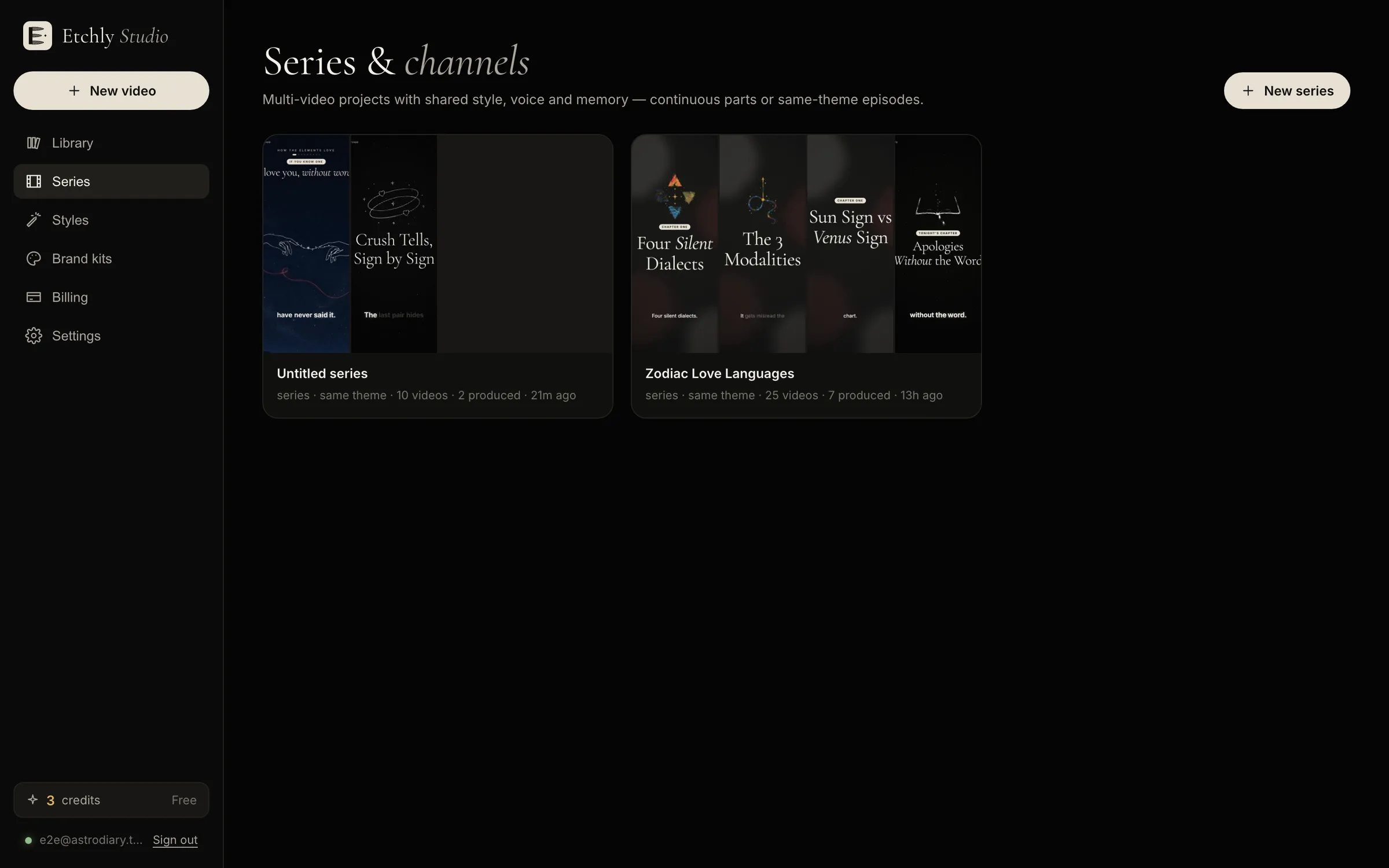
Each one is a repeatable format you can turn into a series, with a new idea in every episode.
History, science, money and psychology topics, told by one narrator over illustrated scenes.
“10 lost cities”, “7 signs you're…”: ranked lists with a progress header and a strong final entry.
Multi-part narratives with episode memory, recaps and cliffhangers that bring viewers back.
Take one misconception per episode in your niche and settle it with sources.
Folklore, astrology, legends and internet history suit an engraved or watercolor look.
Thought experiments in geography, physics or history, with a clear narrative arc.
Plan up to 25 episodes from one prompt with the series planner. A series bible and episode memory keep characters, motifs and running jokes consistent, and each episode can recap the last and tease the next.
That matters on YouTube in particular: viewers subscribe to a format they recognize, and every episode still needs its own story so the channel never feels templated.
Most faceless channels are built on the same stock clips, and viewers notice. Etchly illustrates every scene for your script, in styles like hand-etched engraving, watercolor or line art that draws itself on, and its motion engine adds parallax, camera moves and kinetic titles.
List 50 titles before you commit. If you run dry at 15, keep looking.
Save a style preset with art style, palette, fonts, narrator and caption style. Every upload then looks like your channel.
Use the series planner to outline up to 25 episodes from one prompt, each with its own angle.
Review the script, press produce, fix anything in plain English and upload on a schedule you can keep.
| Aspect ratio | 16:9 landscape, rendered at 1080p |
|---|---|
| Length | Any length. Mid-roll ads are available on videos 8 minutes or longer |
| Captions | Burned in, plus your script for the description |
| Audio | Narration and music mixed and loudness-normalized |
| Ready to post | Title, hook, description and tags with every video |
Real Etchly credit costs for common posting schedules, next to what the same seconds of raw generative footage would cost.
| Posting schedule | Credits / month | Fits on | Etchly / month | Seedance 2.0 footage only |
|---|---|---|---|---|
| 1 long-form video a week (5 min) | ~260 | Starter + 2 credit packs | $69 | $504–$816 |
| 1 long-form + 3 Shorts a week | ~481 | Studio | $99 | $668–$1,081 |
| 2 explainers a week (3 min) | ~376 | Pro + 2 credit packs | $93 | $605–$979 |
Etchly credits assume every video is brand new: ideas, script and production with all-new illustrations. Reusing art across a series, or re-rendering, costs less. The Seedance column is footage only: one 1080p pass at typical third-party rates of $0.42–$0.68 per second (October 2026), with no script, voice, captions or rerolls. Prices change, so check the provider.
Yes. YouTube doesn't require you to appear on camera. What it does police is content that feels mass-produced or reused. In July 2025 it renamed its “repetitious content” policy to “inauthentic content” to make that clearer. Its examples of content that isn't eligible include image slideshows with little narrative or educational value, and AI-generated content made with generic templates that gives the impression of mass production.
To join the YouTube Partner Program you need 1,000 subscribers plus either 4,000 public watch hours in the last 12 months or 10 million public Shorts views in the last 90 days. Policies change, so check YouTube's own pages before you plan around them.
Sources: YouTube channel monetization policies · YouTube Partner Program overview and eligibility. This is general information, not legal advice. Platform rules change, so check the current versions.
Up to 25 episodes from one prompt, with a series bible and episode memory.
Learn moreLine art, engraving, watercolor, neon, paper collage, risograph, 3D clay and cinematic scenes.
Learn moreHundreds of natural voices, tuned pacing, silence tightening and word-level timing.
Learn more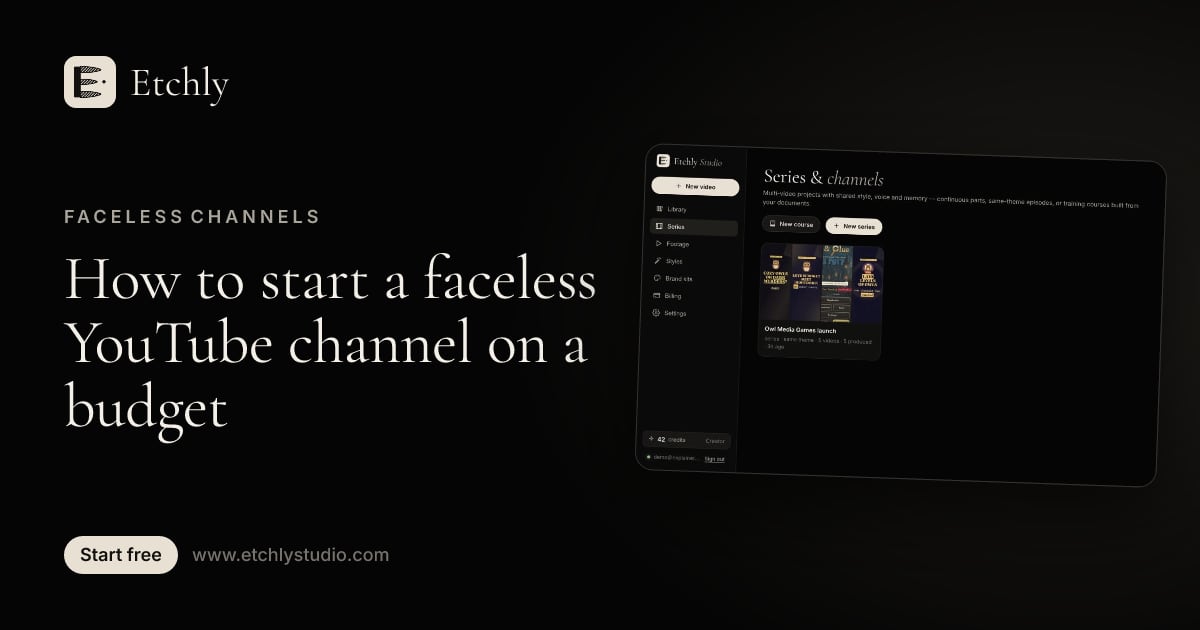
Start a faceless YouTube channel on a budget: pick a niche and format, plan a series, set a posting cadence, and see real monthly costs and monetization.
60 faceless YouTube and TikTok channel ideas in 10 niches, each with an example title, plus how to test a niche, pick a platform and turn it into a series.
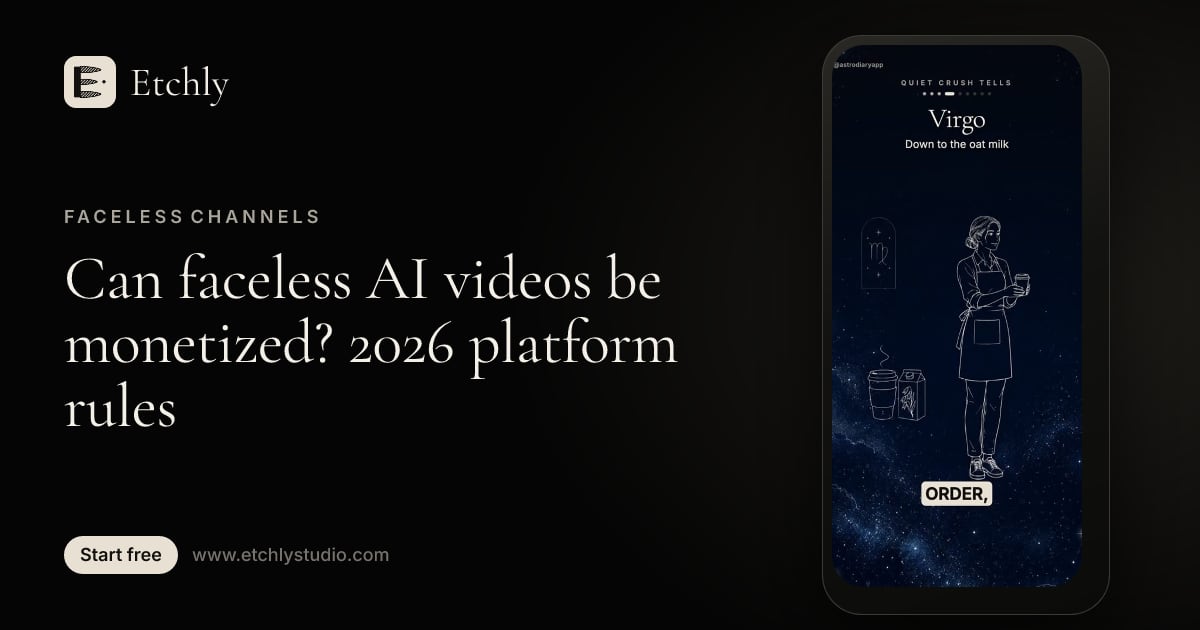
Can faceless AI videos be monetized? What YouTube's inauthentic content policy and TikTok, Instagram and Facebook rules say, plus an eligibility checklist.
A channel where the creator never appears on camera. Videos are carried by narration, visuals, on-screen text and music: explainers, countdowns, stories and documentaries are the most common formats.
No. Pick from hundreds of natural AI voices and keep the same narrator on every episode.
A brand-new 60-second video with 16 illustrations is about 25 credits, or $4–6 depending on plan. A 5-minute video with 40 illustrations is about 65 credits, roughly $11–16. Re-renders that reuse the art are free.
Yes. Give each channel its own brand kit, series and style preset so they never blur together.
Daily 9:16 Shorts with a hook up front, captions burned in and a look viewers recognize.
Learn moreTikTokStory parts, countdowns and explainers in 9:16, with hooks, captions and hashtags ready to post.
Learn moreInstagramOriginal Reels in one signature style, with captions for silent autoplay and a cohesive grid.
Learn moreAlso: Faceless Facebook page · Faceless video maker overview
10 free credits on signup, enough to script and produce a short 15-second video. No card required.